

Last Updated: November 3, 2026
Quick Summary
Centralized shop management runs inventory, purchasing, invoicing, and reporting for every store location from one connected system, replacing separate location-by-location tools. For multi-store auto parts operators, it delivers benefits including inventory accuracy, real-time synchronization, faster procurement, KPI reporting, technician efficiency, lower carrying costs, and one unified dashboard.
- A centralized database replaces per-store spreadsheets with one live record, so a part received in one location is instantly visible everywhere.
- Automated reordering triggers purchase orders when a part’s on-hand quantity crosses a reorder point you define.
- Real-time synchronization updates the central database immediately when a sale, return, or transfer happens in one store.
- Centralized reporting shows which branches hold excess stock on slow movers so you can rebalance before carrying costs grow.
- Plan for training time and name a power user at each location to manage change resistance.
Table of Contents
- Why Centralized Shop Management Matters for Auto Parts
- 1. Inventory Accuracy and Stock Level Optimization
- 2. Real-Time Synchronization Across Every Location
- 3. Faster Procurement and Supplier Integration
- 4. Reporting and KPI Analytics That Drive Decisions
- 5. Technician Efficiency and Workflow Automation
- 6. Lower Carrying Costs and Less Waste
- 7. One Unified Dashboard for Multi-Shop Management
- The Three Things Competitors Skip: Adoption, Migration, and ROI
- Frequently Asked Questions
Why Centralized Shop Management Matters for Auto Parts
Centralized shop management is the practice of running inventory, purchasing, invoicing, and reporting for every store location from one connected system instead of separate location-by-location tools. For multi-store auto parts operators, that shift is no longer optional housekeeping. According to Persistence Market Research’s auto repair software market forecast, the global auto repair software market is projected to reach USD 8.6 billion by 2033, growing at a 14.2% CAGR. The vendors are racing to consolidate because operators are demanding it.
At Blue Sage Software, we have spent over 35 years building ERP, POS, and parts inventory management systems for the automotive aftermarket. Stores that centralize their operations gain a clearer view of stock and can make decisions based on data. For a broader look at the case for cloud ERP across multi-location auto parts stores, that guide covers the key benefits.
Below, we break down the 10 benefits we see most often, plus the operational realities most guides skip: staff adoption, data migration, and how to calculate whether the investment actually pays back.
1. Inventory Accuracy and Stock Level Optimization
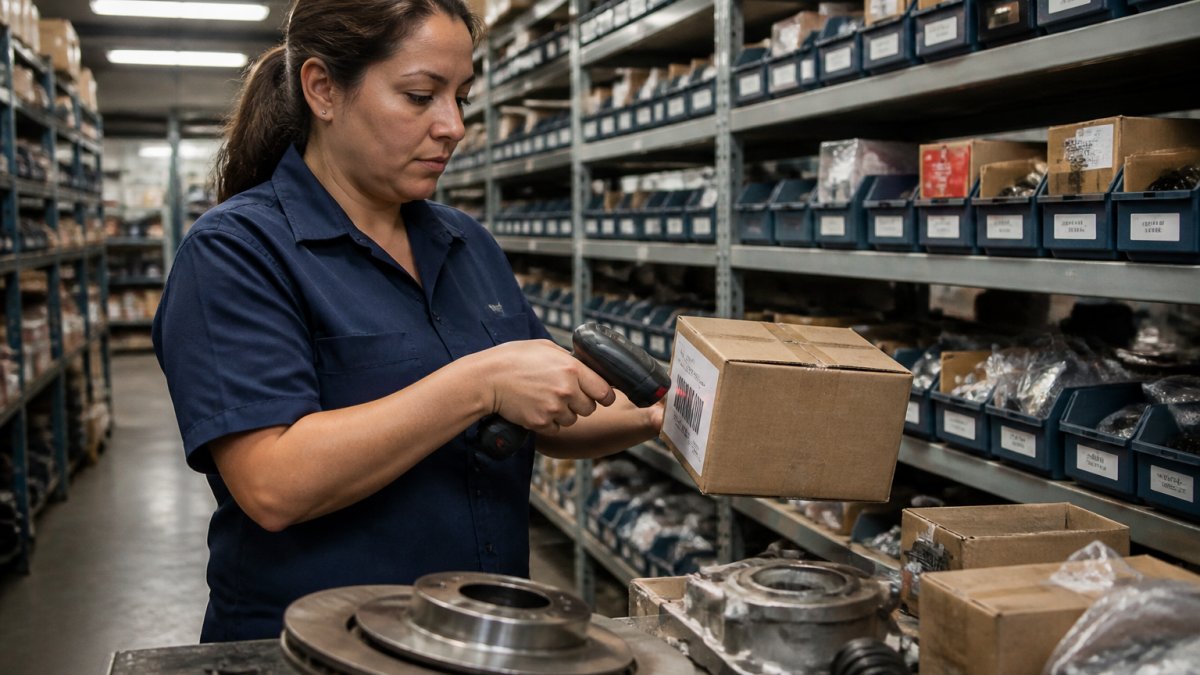
Inventory accuracy is the percentage of your recorded stock that physically exists on the shelf, and it is the number every other benefit depends on. A centralized database replaces per-store spreadsheets with one live record, so a part received in one location is instantly visible everywhere.
The payoff compounds. Finale Inventory’s success stories document Bapmic, an auto parts operation that implemented centralized inventory management and reported a 4x increase in operational efficiency and a 200% improvement in inventory accuracy.
Accuracy depends on workflow discipline as well as software, and barcode scanning at receiving and at the counter helps keep the database reliable. To see how ERP software improves inventory accuracy, that article breaks down the specific mechanisms.
How Automated Reordering Prevents Stockouts
Automated reordering can help prevent stockouts by triggering purchase orders when a part’s on-hand quantity crosses a reorder point you define, rather than when a counter person notices the shelf is empty.
2. Real-Time Synchronization Across Every Location
Real-time synchronization means a sale, return, or transfer in one store can update the central database immediately rather than at the next batch run. For a practical playbook on managing multi-store automotive inventory, that guide covers syncing, demand forecasting, and stock balancing.
3. Faster Procurement and Supplier Integration
Procurement speed depends on how many manual steps sit between a low-stock signal and a purchase order. Centralized systems can shorten that chain and help enforce a consistent purchasing policy across locations.
Integration with supplier catalogs matters here. When part numbers, pricing, and availability pull from supplier data rather than being keyed by hand, ordering errors drop and your buyers spend their time on exceptions instead of data entry. The 2026 Repair Shop Challenges Report from IMR Automotive Research identifies parts and labor issues as a primary challenge shaping the repair shop landscape, which makes procurement workflow a high-use place to start.
Change management is an important part of making centralized procurement succeed. Buyers accustomed to calling suppliers directly may resist a system that routes orders through a central queue, so involving local input can help.
Data migration is an important consideration when moving to a centralized system. Customers should ask vendors for a documented migration plan and confirm how historical data will be validated before go-live.
4. Reporting and KPI Analytics That Drive Decisions
Reporting only creates value when it changes a decision. A centralized platform gives you one version of key performance indicators across every store: inventory turnover by category, gross margin by line, fill rate, and dead stock aging.
Centralized reporting can help you see which branches hold excess stock on slow movers and rebalance before carrying costs grow.
5. Technician Efficiency and Workflow Automation
Technician efficiency can improve when parts information and job status are connected in one workflow, so technicians need not walk to the counter to check whether a part has arrived.
The same logic applies to the service advisor, who can quote accurately and give customers a real timeline instead of a hopeful one. research published in MDPI found that effective communication through centralized systems is essential for building customer trust and improving service efficiency. That is the mechanism: fewer handoffs, fewer surprises.
Adoption is an important human factor when introducing a new workflow. Involving experienced technicians in testing can help identify steps that add time, so that the system supports rather than slows daily work.
Our breakdown of reducing order costs in automotive parts walks through seven concrete steps for cutting waste out of the purchasing cycle.
6. Lower Carrying Costs and Less Waste
Carrying costs fall when you stop holding safety stock in every location to cover uncertainty that a shared view already solves. Centralized visibility lets you hold depth once and move it, rather than duplicating it five times.
Waste reduction can be an important benefit of centralized inventory management, since aged stock can be identified and transfers can reduce the need for new purchases.
Our breakdown of reducing order costs in automotive parts walks through seven concrete steps for cutting waste out of the purchasing cycle.
7. One Unified Dashboard for Multi-Shop Management
Multi-shop management works best from a single dashboard, where owners and operations managers see every location side by side without logging into separate systems. Resource allocation, staffing decisions, and transfer planning all start from the same screen.
Scalability matters as store counts grow. Readers planning expansion can find strategies for scaling multi-location auto retail operations with centralized control and smart KPIs. Blue Sage Software’s platform is built for multi-store operations, and prospects should confirm how it handles their planned location count.
The Three Things Competitors Skip: Adoption, Migration, and ROI
Feature lists are easy. The hard parts of centralization are the ones that decide whether the project succeeds.
Change management. Staff who knew the old system inside out will resist a new one, and some initial learning stress is normal. The auto parts distributor case study on centralized warehouse transitions notes exactly this tension: shops need a balance between local autonomy and standardized process. Plan for training time and name a power user at each location.
Data migration and integration security. Moving years of POS history and parts data is an important phase. Ask vendors for a documented migration plan and how they handle access control and audit trails.
ROI calculation. Build the case on measurable lines: inventory reduction from shared stock, labor hours saved on manual ordering, and sales recovered from cross-store availability.
| Benefit | Primary Metric to Track | Typical Lever |
|---|---|---|
| Inventory accuracy | Record vs. physical variance | Barcode scanning discipline |
| Stockout prevention | Fill rate by location | Automated reordering |
| Procurement speed | PO cycle time | Supplier catalog integration |
| Carrying costs | Inventory turnover | Cross-store transfers |
| Technician efficiency | Jobs completed per day | Workflow automation |
Frequently Asked Questions
How does centralized shop management improve parts inventory accuracy?
A centralized database updates stock counts the moment a part is sold, received, or transferred, so every location sees the same number. Barcode scanning and automated reordering remove manual entry errors that cause overstock and stockouts. The result is tighter inventory turnover and fewer returns from wrong-fit parts. Blue Sage Software offers parts inventory management services for multi-store operations.
What are the primary challenges of managing auto parts across multiple locations?
The biggest challenges are duplicate stock, inconsistent pricing, and no single view of availability. Staff at one store cannot see what another store holds, so they order parts that already sit nearby. Carrying costs rise while service bays wait on deliveries. Centralized shop management can help address this by providing a shared view of inventory across locations.
Can centralized shop management reduce overhead costs for auto parts retailers?
Yes, mainly by cutting carrying costs and waste. When stock levels adjust automatically to demand, you hold less dead inventory and free up cash. Automated invoicing and document management also reduce administrative hours. Centralized systems can help reduce overhead by lowering carrying costs and administrative effort.
What role does real-time data play in centralized parts management?
Real-time data is the backbone of centralized management. It can help keep inventory counts and other operational data current across stores, so decisions can rest on up-to-date numbers. That visibility supports data-driven decision making on reordering, resource allocation, and pricing. Without real-time synchronization, a centralized system is just a shared spreadsheet with extra steps.
