
Table of Contents
- Why Automotive Parts Order Costs Keep Climbing
- Step 1: Apply Lean Manufacturing Principles to Your Parts Operation
- Step 2: Optimize Inventory Management and Turnover
- Step 3: How YMM Fitment Data Accuracy Cuts Return Costs
- Step 4: Strengthen Supplier Relationship Management and Procurement Strategy
- Step 5: Reduce Shipping and Logistics Costs Through Packaging Optimization
- Step 6: Use ERP Software for Auto Parts Distributors to Centralize Operations
- Step 7: AI-Driven Predictive Maintenance and Parts Availability Planning
Last Updated: August 28, 2026
Why Automotive Parts Order Costs Keep Climbing
Reducing order costs in automotive parts is one of the most pressing operational challenges facing distributors and multi-store operators today. At Blue Sage Software, we’ve worked with automotive aftermarket businesses for over 35 years, and the pattern is consistent: order costs rarely shrink on their own. They compound.
The problem isn’t a single line item. It’s the accumulation of inefficiencies across procurement, inventory, fulfillment, and returns. Carrying costs on slow-moving stock, return processing fees on misfit parts, redundant data entry across disconnected systems, and inflated dimensional weight charges from oversized packaging all quietly erode margin on every transaction. According to the Automotive Aftermarket Suppliers Association industry outlook, the number of distinct part numbers in active circulation continues to expand year over year, making inventory decisions harder and more expensive to get wrong.
Below, we’ll walk through seven concrete steps to address this, covering lean operations, YMM fitment accuracy, supplier management, packaging, ERP integration, and AI-driven planning. The goal isn’t incremental improvement. It’s a structural reduction in the cost to process, fulfill, and deliver an order.
| Step | Primary Lever | Impact Area |
|---|---|---|
| 1. Lean manufacturing principles | Eliminate redundant steps | Order processing time |
| 2. Inventory management and turnover | Demand forecasting, JIT delivery | Carrying costs, stockouts |
| 3. YMM fitment data accuracy | Reduce returns at source | Return processing costs |
| 4. Supplier relationship management | Digital procurement | Purchase price, lead time |
| 5. Packaging optimization | Dimensional weight reduction | Shipping costs |
| 6. ERP software centralization | Unified data, automated workflows | Overhead, labor costs |
| 7. AI-driven predictive maintenance | Parts availability planning | Emergency order premiums |
Step 1: Apply Lean Manufacturing Principles to Your Parts Operation
Lean manufacturing principles aren’t just for production floors. Applied to order fulfillment in an automotive parts environment, they’re one of the fastest ways to surface hidden waste and eliminate it without major capital investment.
Value Stream Mapping for Order Fulfillment
Value stream mapping diagrams every step an order takes from placement to delivery, including handoffs, wait times, and decision points. For automotive parts distributors, a typical map reveals more waste than most operators expect: orders sitting in queues waiting for manual stock verification, pick lists requiring cross-reference of multiple screens, and invoices held for manual supervisor approval. None of these steps add value.
The fix isn’t always technology. Reorganizing the pick path to match physical warehouse layout, for example, can reduce fulfillment time without spending anything.
Eliminating Redundant Steps in Order Processing
A common mistake is treating every order identically regardless of complexity. High-volume, low-complexity orders (standard commodity parts with confirmed fitment) should flow through a simplified path with minimal human intervention. Complex orders warrant extra handling time.
Segmenting your order types and building separate workflows for each is a straightforward operational win. It also exposes which order types are genuinely unprofitable to process at current pricing.
Map your five most common order types separately. You’ll almost always find that one or two account for most of your processing cost and least of your margin. That’s where to focus first.
Step 2: Optimize Inventory Management and Turnover
Inventory management is where most automotive parts businesses bleed money without realizing it. Overstock ties up cash and accumulates carrying costs. Understock triggers emergency orders at premium prices and loses sales. The goal is higher inventory turnover with less capital locked in storage.
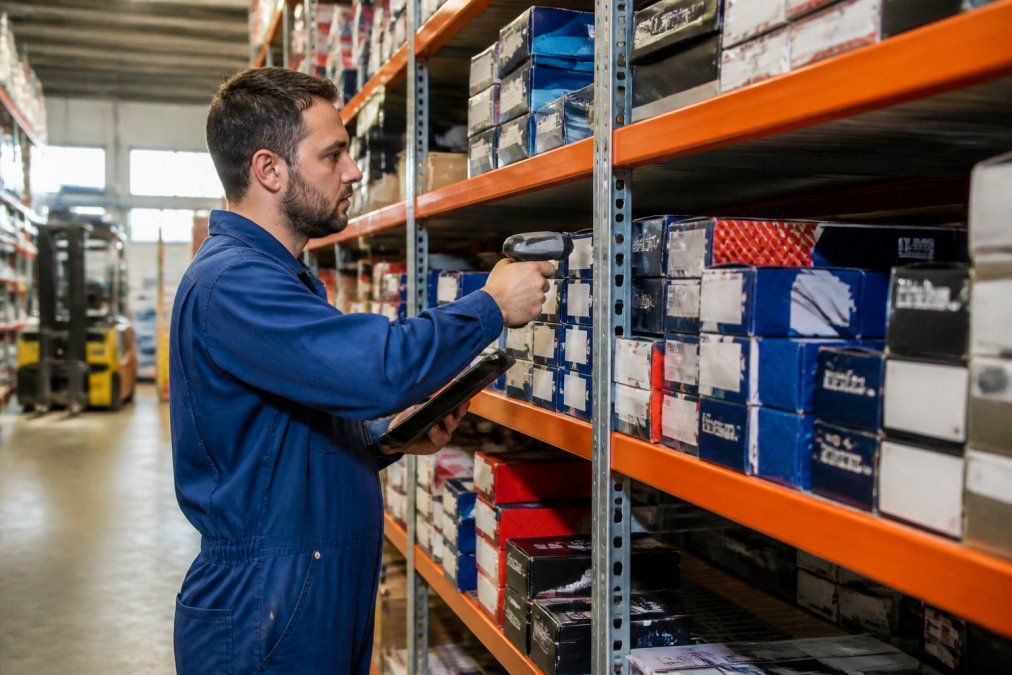
The Warehouse Education and Research Council’s inventory management guidelines consistently identifies carrying cost reduction as one of the highest-ROI operational improvements available to distributors.
Demand Forecasting to Prevent Stockouts and Overstock
Demand forecasting uses historical sales data, seasonal patterns, and market signals to predict what parts you’ll need and when. Without it, ordering decisions default to gut feel and safety stock padding, both of which inflate carrying costs.
For automotive aftermarket businesses, effective forecasting accounts for vehicle age distribution in your market, seasonal repair patterns, and promotional activity. Start with your top 20% of SKUs by volume. Accurate forecasting on high-velocity parts alone will move your inventory turnover numbers meaningfully.
Just-in-Time Delivery and Carrying Cost Reduction
Just-in-time delivery means coordinating with suppliers to receive parts closer to the point of need rather than stockpiling them. This requires reliable supplier relationships and accurate lead time data.
The tradeoff is real: JIT reduces carrying costs but increases exposure to supply chain disruptions. Apply it selectively. High-velocity, reliably sourced parts are good JIT candidates. Specialty parts with long or unpredictable lead times are not.
Applying just-in-time logic to parts with unreliable supplier lead times will generate stockouts and emergency orders, both of which cost more than the carrying costs you saved. Segment your supplier base before changing your stocking model.
Step 3: How YMM Fitment Data Accuracy Cuts Return Costs
YMM fitment data accuracy is the single most underestimated lever for reducing order costs in automotive parts. Year-Make-Model fitment data tells customers whether a specific part fits their specific vehicle. When that data is wrong or incomplete, the result is a return, and returns are expensive.
Return processing involves restocking labor, potential repackaging, supplier return authorization delays, and restocking fees that eat margin on both sides of the transaction. A business processing a high volume of fitment-related returns is essentially paying twice to handle the same order.
Every part in your catalog needs accurate, complete fitment records that account for sub-model variations, engine configurations, and trim levels. A brake pad that fits a base model F-150 may not fit the Raptor variant. If your catalog doesn’t distinguish between them, you’ll generate returns.
For businesses with large catalogs, integrate with a validated fitment data provider and build automated validation into your order entry process. When a customer selects a vehicle and a part, the system should confirm compatibility before the order is placed, not after it’s shipped.
Step 4: Strengthen Supplier Relationship Management and Procurement Strategy
Most businesses treat supplier relationships as transactional. The better approach is to treat them as a procurement strategy asset. Suppliers who trust you, prioritize your orders, and communicate proactively about availability issues are a structural advantage in managing order costs. avoid unexpected repair costs.
Supplier reliability directly affects your ability to execute just-in-time delivery, maintain accurate lead time forecasts, and avoid emergency sourcing. Establish clear performance expectations with key suppliers, track on-time delivery and fill rates, and maintain a documented escalation process when performance slips.
Digital Procurement Platforms and Automated Processes
Digital procurement platforms replace manual purchase order creation, email-based approvals, and spreadsheet tracking with automated processes that reduce labor cost and error rate. According to the Institute for Supply Management’s procurement technology benchmarks, businesses that automate core procurement workflows typically see meaningful reductions in processing time per purchase order and lower error rates in receiving.
Key capabilities include automated purchase order generation triggered by reorder points, supplier portal integration for real-time visibility, three-way matching of purchase orders, receipts, and invoices, and approval workflows routed by value threshold.
Step 5: Reduce Shipping and Logistics Costs Through Packaging Optimization
Shipping cost reduction is one of the most actionable areas in reducing order costs in automotive parts. Carriers charge based on dimensional weight, a formula that accounts for package size, not just actual weight. Oversized packaging for small parts generates inflated transportation fees on every shipment.
Start with a packaging audit. Measure the actual dimensions of your most commonly shipped parts and compare them to the box sizes you’re using. Right-sizing packaging reduces dimensional weight charges and often allows more packages per pallet, reducing freight costs on bulk shipments.
Beyond box sizing, consider poly mailers for small, non-fragile parts, custom-fit packaging for high-volume SKUs, and consolidated shipping for multi-item orders rather than shipping each item separately.
Packaging optimization doesn’t require a capital project. A one-week audit of your top 50 highest-volume SKUs against your current box inventory will identify the biggest dimensional weight inefficiencies. Start there.
Step 6: Use ERP Software for Auto Parts Distributors to Centralize Operations
ERP software for auto parts distributors is the operational backbone that connects inventory, procurement, order processing, and customer management into a single system. Without it, data lives in silos, manual reconciliation consumes labor, and decision-making runs on incomplete information.

Every manual handoff between systems, re-entering an order from one platform into another, reconciling inventory counts between a POS system and a warehouse management tool, represents labor cost and error risk. Centralizing those functions eliminates both.
Blue Sage Software’s platform is built specifically for the automotive aftermarket, with over 35 years of experience engineering solutions for multi-store operations. The system integrates ERP, POS, inventory management, delivery tracking, and eCommerce in a single platform, available as on-premise or cloud-based deployment.
Sustainability-Driven Cost Reduction and Risk Mitigation
Reducing operational waste, right-sizing packaging, optimizing delivery routes, and shifting to digital invoicing all reduce costs and environmental impact simultaneously. For automotive parts distributors serving commercial fleets or municipal accounts, sustainability credentials are increasingly a procurement requirement.
Risk mitigation during cost-cutting deserves equal attention. The most common mistake is cutting too aggressively in areas that create fragility. Reducing safety stock to zero to eliminate carrying costs creates stockout risk that generates emergency order premiums larger than the carrying costs saved. Every cost reduction decision should be evaluated against the risk it introduces.
Step 7: AI-Driven Predictive Maintenance and Parts Availability Planning
AI-driven predictive maintenance represents the forward edge of reducing order costs in automotive parts. Rather than waiting for a part to fail or a stockout to occur, predictive systems analyze usage patterns, vehicle age data, and historical demand signals to forecast when specific parts will be needed and in what quantities.
Traditional parts availability planning is reactive. A fleet customer calls because a truck is down. You either have the part or you don’t. If you don’t, you’re sourcing it at emergency pricing and expediting shipping. Predictive planning shifts that dynamic. By anticipating demand before it becomes urgent, you can stock the right parts at standard cost and standard lead time.
Several ERP and inventory management platforms now incorporate demand forecasting models that use machine learning to improve prediction accuracy over time. The key is feeding them clean, consistent historical data.
For multi-location operations, AI-driven planning enables smarter inventory distribution across locations. Rather than maintaining full safety stock at every store, the system can identify which location is most likely to need a given part and position inventory accordingly, reducing total carrying costs across the network without increasing stockout risk at any individual location.
Reducing order costs in automotive parts requires attacking the problem at multiple layers simultaneously: lean processes, accurate fitment data, supplier relationships, packaging, and centralized technology. Blue Sage Software’s ERP platform gives automotive aftermarket businesses the integrated infrastructure to execute on all of these fronts: real-time inventory visibility across locations, automated order processing, integrated eCommerce, and dependable system performance built on over 35 years of aftermarket-specific experience. Schedule a demo with the Blue Sage Software team to see how centralized operations translate directly into lower order costs for your business.
Frequently Asked Questions
How does poor inventory management impact order costs in automotive parts?
Poor inventory management creates two expensive problems at once: excess stock that ties up cash and accumulates carrying costs, and stockouts that force emergency orders at premium prices. For automotive parts distributors, inaccurate stock data also means ordering parts already on hand. The result is inflated procurement spend, higher warehousing overhead, and slower order fulfillment. A centralized inventory system with real-time visibility across locations directly addresses each of these failure points.
How can YMM fitment data accuracy reduce return costs?
When Year-Make-Model fitment data is incorrect or incomplete, customers receive parts that don't fit their vehicles. Each return generates reverse logistics costs, restocking labor, and a potential lost sale. For aftermarket parts distributors handling high SKU volumes, even a modest reduction in return rates produces measurable savings. Accurate YMM data at the point of sale prevents wrong-part orders before they ship, which is far cheaper than processing returns after the fact.
What role does ERP software play in reducing automotive parts overhead?
ERP software for auto parts distributors consolidates purchasing, inventory, invoicing, and order fulfillment into one system. That consolidation eliminates duplicate data entry, reduces manual errors in procurement, and gives managers accurate demand forecasting data. Automated invoice management alone removes hours of administrative labor per week. For multi-store operations, centralized ERP visibility also prevents over-ordering at one location while another location runs short on the same SKU.
What are the most effective ways to reduce supply chain costs in the automotive aftermarket?
The highest-impact tactics are improving inventory turnover to reduce carrying costs, tightening YMM fitment data to cut returns, consolidating suppliers for better volume pricing, and automating order processing to remove manual steps. Packaging optimization that reduces dimensional weight also lowers transportation fees meaningfully. Longer term, digital procurement platforms and AI-driven demand forecasting reduce both lead times and emergency order frequency, which are two of the largest hidden cost drivers in aftermarket parts supply chains.
This article was written using GrandRanker