

Last Updated: November 4, 2026
Quick Summary
Streamline automotive parts delivery tracking in 2026 by using software that dispatches, tracks, and syncs inventory in real time across every store. Add route optimization, proof of delivery, and automated customer notifications, and extend tracking to core returns and oversized parts.
- Online auto parts sales reached $44.6 billion in 2025, multiplying handoffs that break tracking.
- Most distributors can cut delivery times 30% to 50% with better routing and logistics technology.
- 18% of customers consider a delivery late the moment the promised window passes.
- Tag delivery records with store, part category, and day of week, then review 90 days monthly.
- 61% of aftermarket professionals expect parts demand to grow in 2026.
Table of Contents
- Why Delivery Tracking Breaks Down as Parts Operations Grow
- Auto Parts Delivery Tracking Software: What to Look For
- Auto Parts Delivery Route Optimization That Cuts Lead Times
- Real-Time Delivery Tracking for Auto Parts: Building Customer Visibility
- Auto Parts Delivery Time Management: Setting Windows You Can Hit
- Handling the Deliveries Most Systems Ignore: Core Returns and Oversized Parts
- Turning Delivery Data into Demand Forecasting and Driver Accountability
- Schedule a Demo to See Tracking Across Every Store
- Frequently Asked Questions
Why Delivery Tracking Breaks Down as Parts Operations Grow
Online auto parts sales hit $44.6 billion in 2025, according to Scube Marketing’s market analysis, and every one of those orders has to land somewhere. At Blue Sage Software, we have spent more than 35 years watching parts businesses grow from one counter to eight locations. The pattern is predictable: the tracking that worked at one store falls apart at three.
Why? Because growth multiplies the handoffs. A part moves from warehouse to truck to counter to installer, and each handoff is a chance for the trail to go cold. Spreadsheet tracking cannot keep up. Phone calls to drivers cannot keep up either.
Here is the core problem most guides miss: delivery tracking is not a shipping feature. For a same-topic explanation of why real-time delivery tracking matters in automotive, see our dedicated article. It is an inventory feature wearing a shipping hat. When tracking breaks, your stock counts break with it.
- One store: the owner knows where every part is
- Three stores: transfers between locations get logged late or not at all
- Eight stores: nobody can say which truck carries which order without calling someone
That is the wall. Below, we walk through how to simplify automotive parts delivery tracking in 2026, from software selection to route planning to the messy deliveries most systems ignore.
Auto Parts Delivery Tracking Software: What to Look For
Auto parts delivery tracking software is a system that records every part’s location, from warehouse shelf to customer door, and shares that status across all your locations in real time. The right system does three jobs at once: it dispatches, it tracks, and it syncs inventory.
Real-time visibility is now a baseline expectation, not an upgrade. Clean Fleet Report’s 2026 tracking outlook found that customers in the automotive transport sector treat live tracking as a fundamental requirement.
Core Features That Matter for Multi-Store Operations
Multi-store parts businesses need features a single-location shop can skip. Our checklist for evaluating any platform:
- Live delivery status visible from every store, not just the dispatching one
- Dispatch management that assigns drivers by route, not by guesswork
- Proof of delivery with digital signature capture at the counter
- Automated notifications sent to the customer when a part ships
- API integration with your POS and accounting tools
- Cloud-based or on-premise deployment, whichever fits your IT setup
That last point matters more than vendors admit. Some chains want cloud-based logistics; others have on-premise infrastructure they trust. Insist on choice.
For a deeper look at running inventory across locations, see our guide to multi-store automotive inventory management.
Parts Inventory and Order Fulfillment Sync
Inventory synchronization is where tracking earns its keep. When a driver marks a part delivered, the stock count at the receiving store should update in the same moment. If it does not, you get phantom inventory: parts the system says you have and the shelf says you do not.
Watch out: if your tracking tool and your inventory system do not talk to each other, you will reconcile counts by hand every week, and the errors compound fast.
Strong parts inventory management closes that loop automatically.
Here is the feature checklist multi-store parts operations should use when evaluating any tracking platform.
| Feature | What it does |
|---|---|
| Live delivery status | Visible from every store, not just dispatching one |
| Dispatch management | Assigns drivers by route, not guesswork |
| Proof of delivery | Digital signature capture at the counter |
| Automated notifications | Sent to customer when a part ships |
| API integration | Connects with POS and accounting tools |
| Deployment choice | Cloud-based or on-premise, whichever fits IT setup |
Auto Parts Delivery Route Optimization That Cuts Lead Times
Route optimization is the practice of sequencing stops so drivers cover less distance and hit tighter windows. Done well, it is the fastest lever you have. According to Zeo Route Planner’s 2026 logistics analysis, most distributors can cut delivery times by 30% to 50% with better routing and logistics technology.
Where do those minutes come from? Three places:
- Delivery density. Group stops by zone so drivers are not crossing town twice.
- Sequenced dispatch. Load trucks in reverse stop order so the last delivery goes in first.
- Exception handling. Reroute around a closed shop without rebuilding the whole day’s plan.
Automotive aftermarket routes have a wrinkle general couriers do not: many stops are repair shops that close at a set hour. Miss that window and the part sits until tomorrow, which means a bay sits idle. Route optimization for auto parts has to weight shop closing times, not just mileage. Because a missed shop window can turn automotive parts shipping into a next-day delay, aligning dispatch times with delivery cutoffs matters just as much for genuine European parts.
Real-Time Delivery Tracking for Auto Parts: Building Customer Visibility
Real-time delivery tracking for auto parts is the practice of sharing live order status with the customer, from dispatch to drop-off. It changes the conversation. Instead of “where is my part,” the customer watches the truck move.
Speed of information matters because perception is unforgiving. Roadie’s 2026 delivery research reports that 18% of customers consider a delivery late the moment the promised window passes. Not an hour later. The moment.
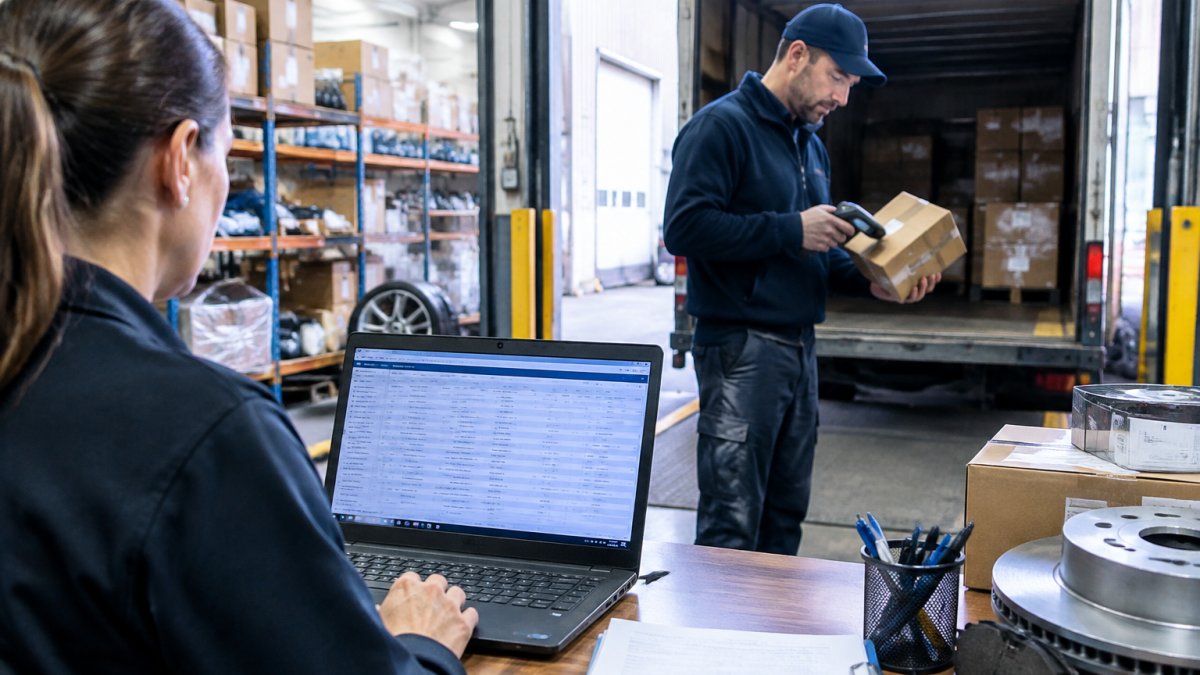
What customers actually want:
- A delivery window they can plan around
- Automatic status updates at dispatch, en route, and delivered
- Proof of delivery they can check without calling you
- One place to look, not three phone numbers
The same visibility your customer sees should appear on your counter screens. When a tech asks whether a part arrived, the answer should be on the screen, not in someone’s memory. Our 2026 guide to real-time delivery tracking for auto parts retail covers the customer-facing side in more detail.
Auto Parts Delivery Time Management: Setting Windows You Can Hit
Delivery time management is the discipline of setting windows your drivers can actually meet, then measuring against them. A window you miss is worse than a window you never promised.
Start with your own data. Pull the last 60 days of delivery times by route and by zone. Most distributors find a wide spread: some routes finish early, some run long every single day. The long ones are your scheduling problem, not your drivers’ problem.
A practical approach:
- Set windows from historical median times, not best-case times
- Add a buffer for shop-closing stops
- Publish the window to the customer at dispatch
- Review misses weekly and adjust the route, not the promise
Delivery lead times are a promise about your operation. Treat them that way.
Handling the Deliveries Most Systems Ignore: Core Returns and Oversized Parts
Two delivery types break most tracking systems: core returns and oversized parts. Neither fits the standard “pick, pack, ship” mold, so neither gets tracked properly. Most guides skip them entirely, which is why they remain a persistent source of shrinkage and missed credits.
Core returns move backward through your network. A rebuilt part comes back, a core goes out. If your system only tracks outbound deliveries, cores vanish into a gap. Our article on managing automotive core returns walks through the workflow in full.
Oversized parts bring their own problems. Bumpers, hoods, and glass need special handling, and a damaged delivery means a remade order. Track these with photo proof at pickup and delivery, and flag them so the right truck gets assigned.
Watch out: a system that treats every delivery the same will quietly lose track of both categories, and the losses show up as shrinkage you cannot explain. The same parts inventory discipline you apply to outbound stock must extend to returns and bulky items, or the loop stays open.
Turning Delivery Data into Demand Forecasting and Driver Accountability
Every tracked delivery produces data: route times, stop counts, delivery exceptions, proof-of-delivery timestamps. Most businesses collect it and never read it. That is wasted use. The unique angle here is to close the loop between delivery history and inventory placement, not just report on it.
Post-delivery analytics feed demand forecasting directly. If zone 4 gets a parts delivery every Tuesday, the forecast for zone 4 should know that. Patterns in delivery volume predict demand better than gut feel, and 61% of aftermarket professionals expect parts demand to grow in 2026, per the AAPEX State of the Automotive Aftermarket survey.
Driver performance is the other half. Telematics and delivery logs show which routes run long, which drivers hit windows, and where bottlenecks repeat. Use it to coach, not to punish. The goal is delivery accuracy, and accuracy comes from feedback loops.
One more thing: data privacy rules are tightening. Automakers face more aggressive enforcement and state-specific rules on data handling in 2026, according to Nelson Mullins’ privacy outlook. Know what your tracking system collects and why, and keep driver monitoring scoped to delivery performance rather than personal data.
Schedule a Demo to See Tracking Across Every Store
Reading about tracking is not the same as watching it work across eight locations. A demo shows you the dispatch board, the live map, and the inventory sync in motion.
Before you book, know what to evaluate. Our guide to what to look for in an automotive parts store software demo gives you the questions to ask and the screens to request.
Blue Sage Software has spent over 35 years building ERP, POS, and inventory management for the automotive aftermarket, with a team carrying more than 100 years of combined experience. Our platform runs on-premise or in the cloud, tracks deliveries in real time, and keeps inventory synced across every store. Childersburg Truck Service put it simply: “the system is dependable. We don’t experience downtime.”
Frequently Asked Questions
How long do car parts take to get delivered?
Timelines vary by part type and sourcing. Locally stocked parts often move same-day or next-day, while special-order and dealer-transfer parts can take several days. The practical lever is not a single promise but accurate delivery windows backed by real-time delivery tracking for auto parts, so customers see status changes before the window closes.
What information should an auto parts delivery tracking system provide?
At minimum: order status updates, GPS location of the vehicle, estimated arrival windows, proof of delivery with digital signature capture, and exception alerts when a stop is delayed. For multi-store operations, it should also sync with parts inventory so a dispatched order reflects actual stock. Cloud-based logistics platforms with API integration push these updates to your storefront and to customer notifications automatically, which reduces inbound status calls.
How can auto parts businesses reduce delivery delays?
Start with route optimization and realistic delivery scheduling rather than faster driving. Customers often judge a delivery as late the moment the promised window passes, so padding windows with honest estimates protects satisfaction. Pair that with dispatch management that flags delivery exceptions early, and use post-delivery analytics to spot recurring bottlenecks by route and driver.
What software helps manage auto parts deliveries?
Look for auto parts delivery tracking software built for the aftermarket rather than generic courier tools. It should combine route optimization, real-time visibility, proof of delivery, and inventory synchronization in one system. Blue Sage Software has provided ERP, POS, and inventory management to the automotive aftermarket for over 35 years, with delivery tracking and parts inventory management in a single platform that runs on-premise or in the cloud. Schedule a demo to see how it handles multi-store dispatch.
If your delivery tracking still depends on phone calls and spreadsheets, the gap widens every quarter. Get started with Blue Sage Software and see live tracking, route dispatch, and synced inventory running across all your stores. Schedule a demo and bring your toughest multi-store question with you.
