
Last Updated: November 9, 2026
Quick Summary
Managing same-day auto parts deliveries works best when you first sort orders into segments: emergency same-day, scheduled next-day or time-windowed, and flexible replenishment. From there, set up delivery management software, enable real-time tracking, plan routes around urgency, and protect order accuracy with clean Parts Inventory records.
- Tag each order as emergency same-day, time-windowed, or flexible replenishment when it enters your system.
- Give every driver a device or app that reports location and status.
- Send customers a notification when the order leaves the shop and again when it is near.
- Keep a dedicated driver for hotshot runs during peak hours, even if they sit idle between calls.
- Check each order at pick, pack, and handoff, and update Parts Inventory as soon as a part leaves the shelf.
Table of Contents
- Why Same-Day Auto Parts Deliveries Are Growing
- Step 1: Set Up Your Delivery Segments
- Step 2: Add Auto Parts Delivery Management Software to Your Workflow
- Step 3: Enable Same-Day Auto Parts Delivery Tracking
- Step 4: Apply Auto Parts Delivery Route Optimization
- Step 5: Protect Auto Parts Delivery Order Accuracy
- Your Next Step: Map Your Current Delivery Workflow
- Frequently Asked Questions
Same-day auto parts deliveries have moved from a nice-to-have to a daily expectation for many shops. Automotive aftermarket businesses handle this every day, and the pressure is real. A bay sitting idle while a part is on the way costs the shop money, and it costs the customer patience. The good news is that a same-day delivery program can be run with a clear structure. This guide walks through the steps we recommend, from sorting orders into the right delivery segments to protecting order accuracy at the last mile.
Managing same-day auto parts deliveries well starts with knowing what you are trying to solve. Some orders are urgent, some can wait a day, and some are simply restock runs. Treating them all the same is how deliveries get late and drivers get frustrated.
Why Same-Day Auto Parts Deliveries Are Growing
Same-day delivery is part of a rapidly expanding market. Fortune Business Insights projects the global same-day delivery market will reach USD 67.21 billion by 2034, with a 20.96% CAGR over 2026-2034 (Fortune Business Insights, Same Day Delivery Market Size, Industry Share). That forecast covers the broader market, not auto parts alone, but it shows where buyer expectations are heading.
Retailers and wholesalers are responding with local delivery partners. Roadie describes same-day and last-mile delivery solutions built for automotive parts and tire companies (Roadie, Auto Parts Delivery Solutions for Businesses). For a shop, that means urgent parts can often arrive the same day without holding large stock on the shelf.
A common mistake is adding same-day service to every order. That approach strains drivers and makes it hard to keep promises. Start by deciding which orders truly need same-day speed.
Step 1: Set Up Your Delivery Segments
Before you dispatch anything, split incoming orders into clear categories. Blue Sage Software’s delivery tracking guidance describes three common segments: emergency same-day, scheduled next-day or time-windowed, and flexible replenishment (Blue Sage Software, Real-Time Delivery Tracking for Auto Parts Retail).
- Emergency same-day: A vehicle is down and a bay is waiting. Dispatch first.
- Scheduled next-day or time-windowed: The job is booked, and the part must arrive before a set time.
- Flexible replenishment: Restock orders that can ride along on routine runs.
Tag each order with its segment when it enters your system. Drivers then know which stops are urgent without asking.
Step 2: Add Auto Parts Delivery Management Software to Your Workflow
Spreadsheets and phone calls break down once you run more than a few drivers. Delivery management software gives you one place to see orders, assign stops, and update customers. Many shops evaluate several tools before choosing one, and it helps to compare how each handles order intake, dispatch, and status updates.
Blue Sage Software provides ERP, POS, and inventory management built for the automotive aftermarket. For a closer look at how stock control supports delivery planning, read our guide on parts inventory management.
Keep the workflow simple at first. Connect order intake to dispatch, then add customer notifications once that runs smoothly.
Step 3: Enable Same-Day Auto Parts Delivery Tracking
Tracking tells you where a driver is, how long a stop is taking, and whether a part has arrived. Blue Sage Software’s real-time tracking approach records data such as speed, direction, engine status, and dwell time (Blue Sage Software, Real-Time Delivery Tracking for Auto Parts Retail). Those records help you spot delays before the customer calls.
Set up tracking in three parts:
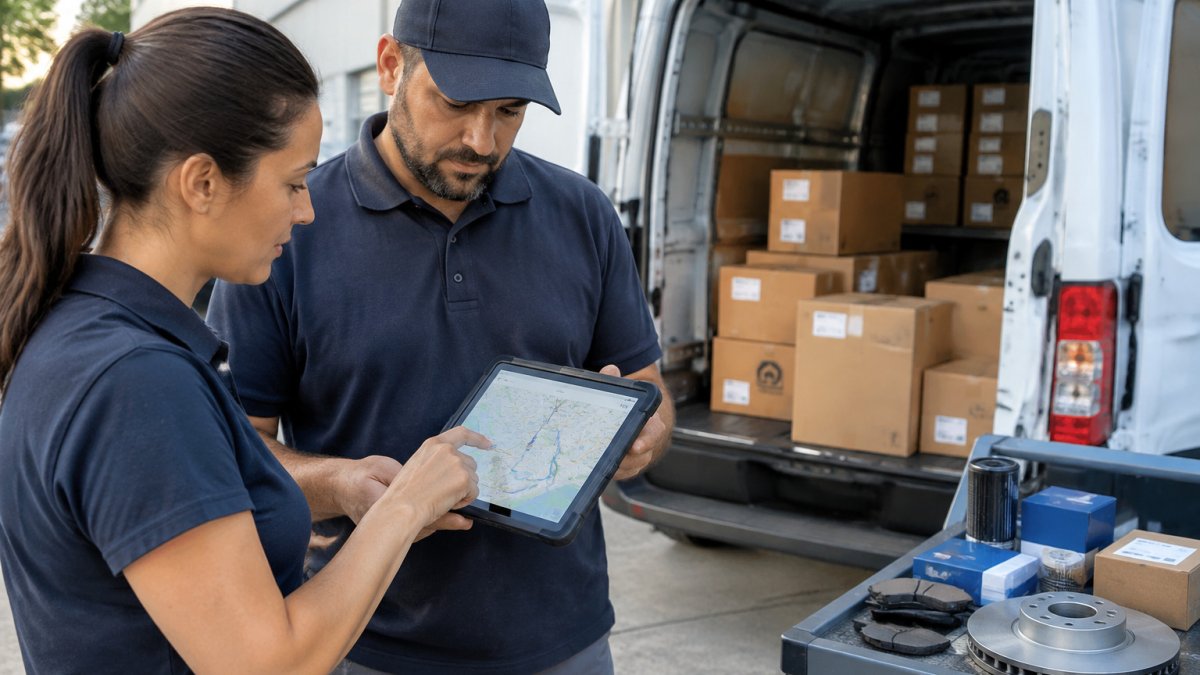
- Give every driver a device or app that reports location and status.
- Send customers a notification when the order leaves the shop and again when it is near.
- Record proof of delivery at each handoff, with a name or signature.
Once tracking is running, review the data each week. Look for stops that always run long and ask why.
Step 4: Apply Auto Parts Delivery Route Optimization
Route planning has a direct effect on how many same-day orders you can complete. Good routing groups nearby stops, sends emergency orders first, and avoids doubling back.
Start with the mechanics. A workable same-day route has four inputs: the delivery segment (emergency, time-windowed, or replenishment), the geographic cluster, the vehicle capacity, and the driver’s remaining hours. Dispatch should build routes in that order. Emergency stops get assigned first and anchored to the nearest available driver; time-windowed stops get slotted around them; replenishment runs fill the remaining capacity.
A common pattern among shops that scale same-day delivery is to separate “hotshot” runs from “milk runs.” Hotshot runs carry one or two emergency parts directly to a single shop. Milk runs follow a fixed loop through a cluster of accounts and carry multiple orders. Mixing the two on one route is the fastest way to make a time-windowed delivery late.
Route optimization depends on accurate data. If your part numbers, addresses, or delivery windows are wrong in the system, the resulting route will be wrong too. Clean the data before you rely on it.
The cost-benefit question competitors avoid
A practical way to decide whether to optimize in-house or outsource is to calculate your current cost per same-day stop. Add driver wages, vehicle costs (fuel, maintenance, insurance), dispatch labor, and the cost of failed or late deliveries (replacement trips, credits, lost bay time). Divide by the number of same-day stops per week. That number is your baseline. Then compare it to the fully loaded cost of a third-party local delivery partner, including their per-stop fee and any surcharges for oversized parts or after-hours runs. If the outsourced cost is lower than your baseline and your volume is steady, outsourcing may win. If your volume is spiky or your parts are high-value and need a known driver, in-house often wins on control even at a higher per-stop cost.
Routing during peak demand and disruptions
Peak demand, end of month, severe weather, a local parts shortage, breaks rigid routes. The shops that handle it well pre-build a “surge route” that covers the highest-density cluster of accounts with a single driver and a fixed sequence. When volume spikes, dispatch activates the surge route and moves non-urgent replenishment to the next day. This is a capacity decision, not a software feature.
For how stock levels across several locations affect where parts should ship from, see how to manage automotive inventory across multiple locations. And because route accuracy depends on clean stock records, keep your Parts Inventory counts current, a route that sends a driver to an empty shelf is worse than no route at all.
The article lays out how to sort same-day stops in order of urgency, so this table summarises the three routing patterns it describes.
| Route type | Typical stops | Key difference |
|---|---|---|
| Hotshot run | One or two emergency parts to one shop | Dedicated driver, dispatched first |
| Milk run | Fixed loop through a cluster of accounts | Carries multiple orders in sequence |
| Surge route | Highest-density cluster of accounts | Pre-built for peak demand |
Step 5: Protect Auto Parts Delivery Order Accuracy
A wrong part on a same-day run costs twice: the shop loses the bay time, and the driver makes a second trip. Order accuracy depends on clean inventory counts and a check before the van leaves. Checking each item at handoff also helps keep orders straight when parts are routed across several locations, where Cambridge Courier Services Ltd can connect the same accuracy checks to the wider delivery process.
But accuracy is not only about the right part number. It is also about the right condition, the right paperwork, and the right handling. A remanufactured alternator that arrives without its core-return tag creates a return dispute. A battery that tips over in transit because it was not secured creates a safety and compliance problem. These are the failure modes that generic delivery guides ignore.
Build a three-point accuracy check
A practical pattern is to check the order at three points: pick, pack, and handoff. At pick, the counter person confirms the part number and quantity against the order and scans it out of Parts Inventory. At pack, a second person confirms the part matches the vehicle description (engine, trim, side) and that any core, gasket, or hardware is included. At handoff, the driver scans the part and captures a signature or name from the receiving shop. If any point fails, the order stops there.
If your stock records drift from what is on the shelf, every same-day promise becomes a risk. Our auto inventory accuracy cycle count guide covers how to keep those counts reliable.
Watch out: if a part is pulled for an emergency order, update Parts Inventory immediately. A stale count can send the next driver to a shelf that is already empty.
Handle returns and core exchanges on the same run
Same-day delivery often means same-day returns. A shop that receives a wrong part wants it picked up on the next run, and core exchanges (old alternators, starters, compressors) need to travel back to the supplier. Build a return slot into every route: the driver carries a return tote and a core tag log. At handoff, the driver notes any return or core on the delivery record. This keeps returns from piling up at the counter and gives you a paper trail if a core credit is disputed.
Document the handoff for compliance and disputes
Proof of delivery should capture more than a signature. For high-value parts, record the time, the driver, the receiving person’s name, and a photo of the part in its packaging. For hazardous items, batteries, fluids, refrigerants, the driver should confirm the item is upright and secured, and the delivery record should note that the package was intact at handoff. These records matter if a customer claims a part arrived damaged or if a warranty dispute arises later. They also support your own insurance and safety reviews.
Accuracy is a Parts Inventory problem first
Most delivery errors start in the stock record, not the van. If your Parts Inventory is accurate, bin locations, quantities, and part supersessions, the pick is fast and correct. If it is not, no amount of driver training will fix it. Treat every same-day delivery as a test of your inventory data, and investigate every miss as an inventory problem before you blame the driver.
Your Next Step: Map Your Current Delivery Workflow
Start by writing down how an order moves today, from the moment it arrives to the moment a customer signs for it. Mark where the delays happen and where errors creep in. Then apply the five steps above one at a time, beginning with delivery segments, since everything else depends on knowing what is urgent.
Blue Sage Software provides ERP, POS, and inventory management for automotive aftermarket businesses. If you want to see how it fits your operation, request a demo to walk through your current workflow with our team.
Frequently Asked Questions
How can auto parts stores manage same-day deliveries?
Start by sorting orders into time-based categories: emergency same-day, scheduled next-day or time-windowed, and flexible replenishment. Give each category its own cutoff time and dispatch rule. Then use delivery software that records each stop, status change and proof of delivery in one place. Review the cutoff times monthly against actual dispatch data, because late-afternoon orders are usually where same-day commitments break down first.
What is the best way to track auto parts deliveries in real time?
Use a system that pulls driver location, stop status and timestamps into a single dashboard visible to both the counter staff and the customer. Set automatic notifications for dispatch, arrival and completed handoff. Tracking only helps if the parts counter can see it, so confirm that your dispatch and sales screens share the same order record.
How can businesses reduce errors in same-day auto parts orders?
Most errors come from mismatched part numbers, incomplete vehicle details and manual re-keying between systems. Require vehicle year, make, model and engine information on every request, and verify part numbers against the order before dispatch. Keep a documented handoff step where the receiving customer confirms the part and quantity before the driver leaves.
